Skip to Main Content
← All Case Studies
MediaTech · Headless CMS · RU / KZ / EN

Insider CMS — headless platform for multilingual media

Functional MVP

A custom editorial platform with content import, three language versions, a visual builder, media library and a fast, SEO-ready portal.

Next.js 14 / 16React 18 / 19Express.js 4PostgreSQL 16Prisma 5Docker
262TS/TSX file
76REST handlers
35admin-panel screens
20block types
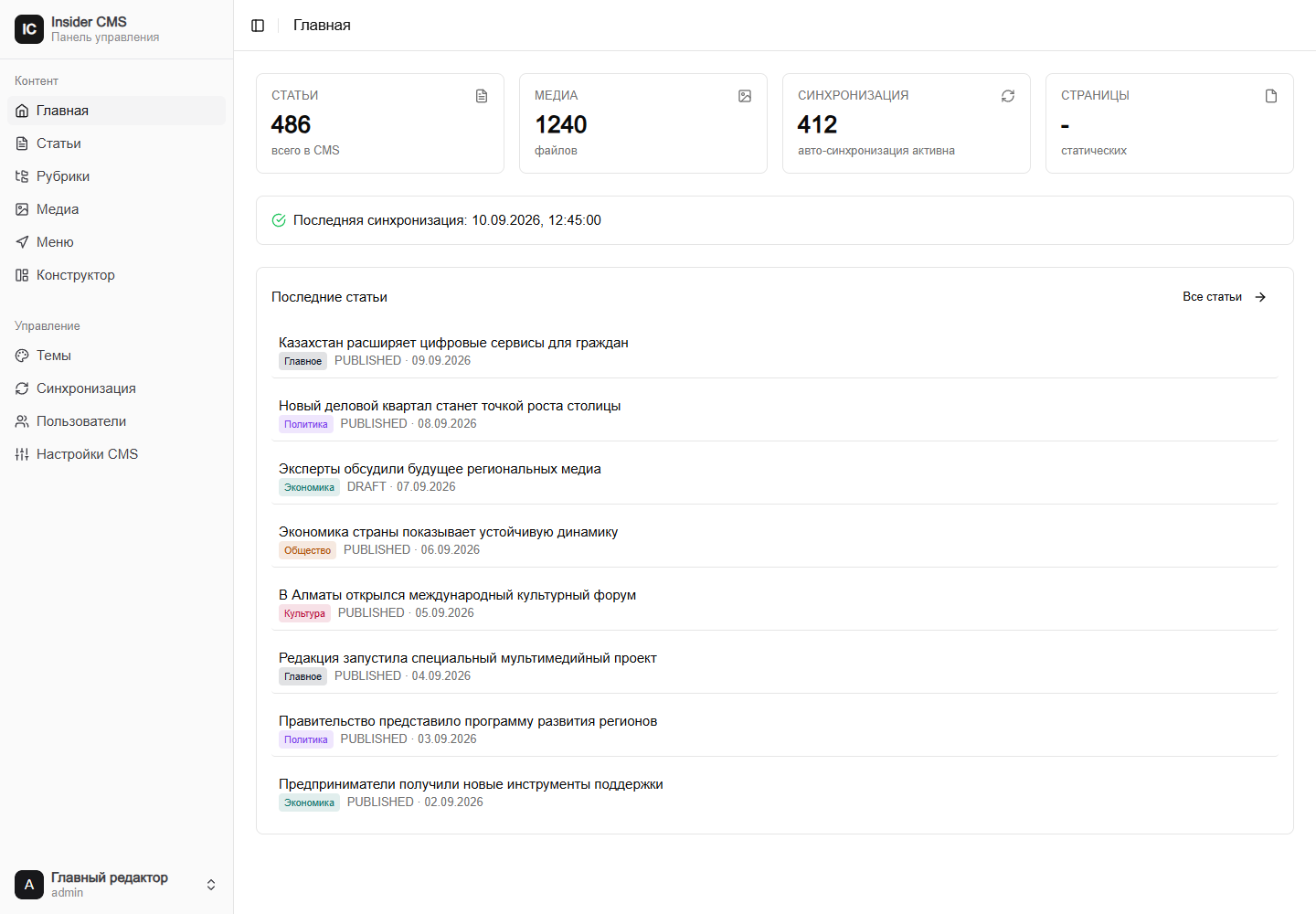
Editorial Dashboard — Insider CMS
Editorial DashboardLive interface · actual product interface
01 / Context

The newsroom needed a controlled publishing workflow, not another article submission form

Content arrives from an external platform, undergoes editorial review, is translated into Russian, Kazakh and English, receives media and a publication date, and then needs to appear on the website quickly. Manual transfers, disconnected translations and developer dependency slowed this cycle. We separated the product into an API, an editorial panel and an independent public frontend.

Challenge
Eliminate manual chaos from multilingual editorial workflows
Solution
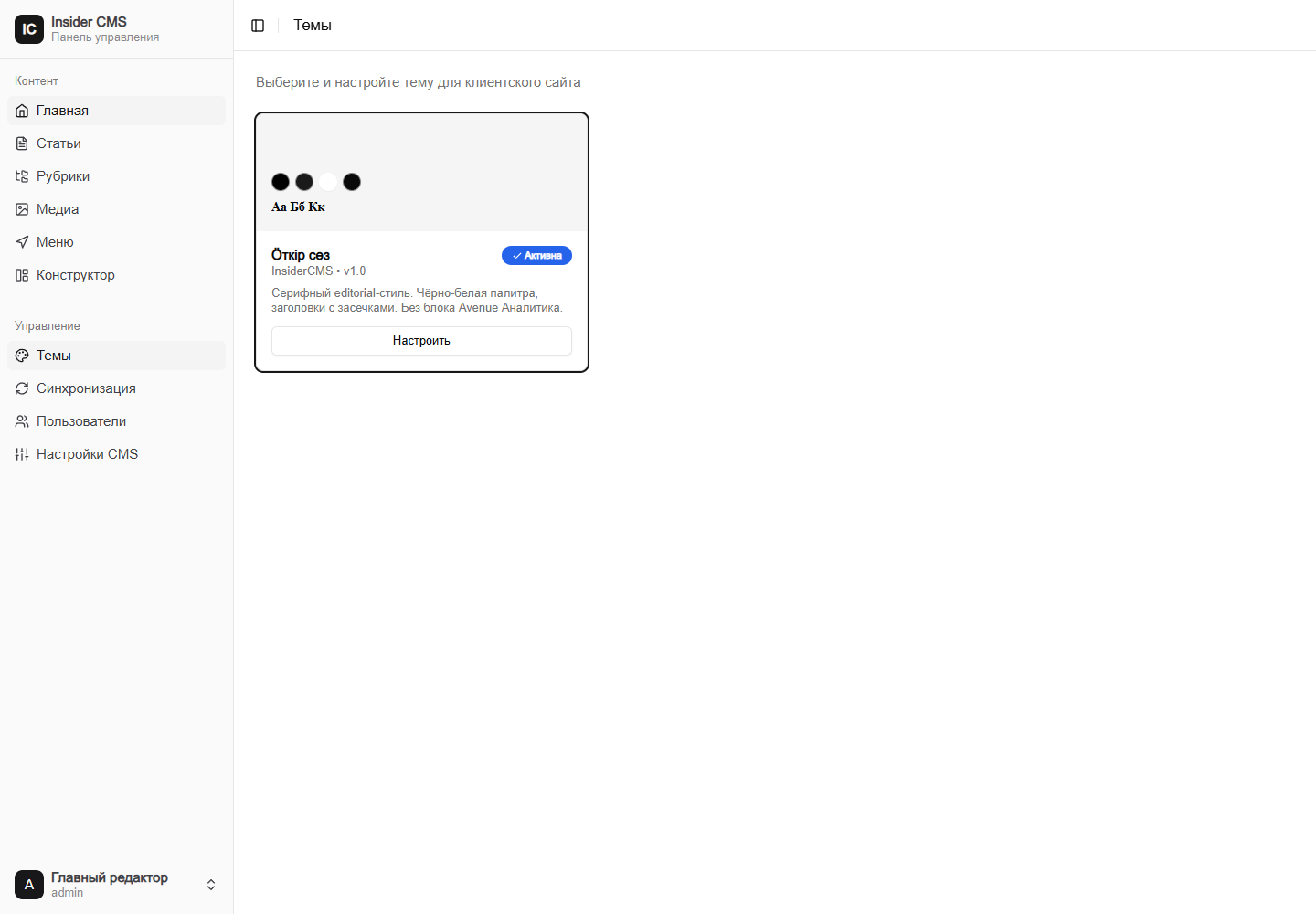
Headless CMS, automatic synchronization and page builder
02 / Pain Point → Solution

The solution sale begins with the editorial team’s daily pain points

01

Content Is Spread Across Different Tools

Articles, images, translations, menus and settings are managed separately, leading to migration errors.

Our Solution

We brought Article, Translation, Category, Media, Menu and Settings together in a shared model and a single working interface.
02

Language Versions Drift Apart

Editors cannot see which translations are ready, published or scheduled.

Our Solution

We made RU/KZ/EN independent entities with their own status, date, SEO fields and readiness controls.

03

The Website Depends on the Developer

Changing the homepage, section or block order requires code changes.

Our Solution

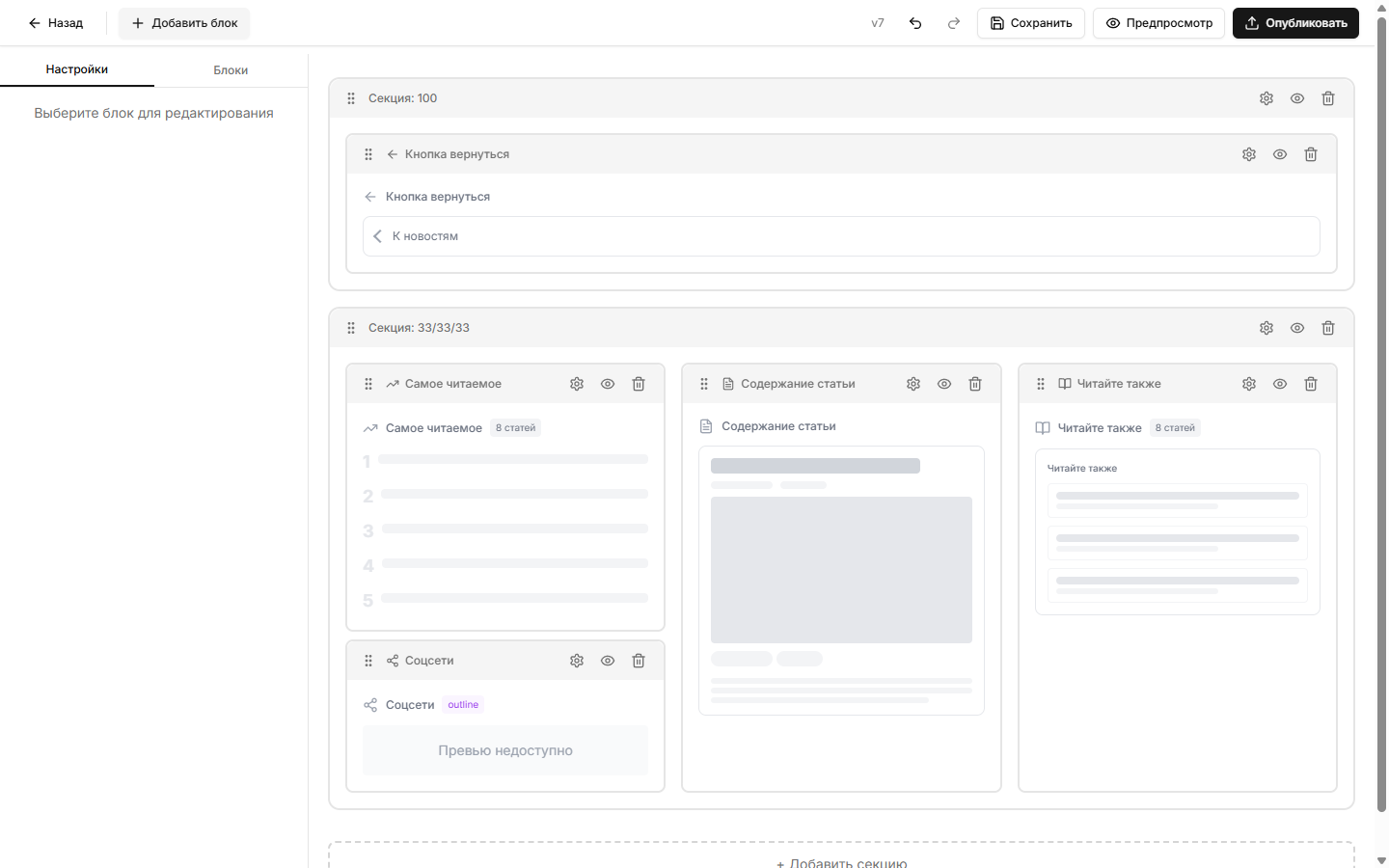
We created a drag-and-drop builder with 20 block types, draft and preview modes, and independent layout publishing.

04

Imports Take Too Long

Content from Insider has to be transferred, categorised and checked manually.

Our Solution

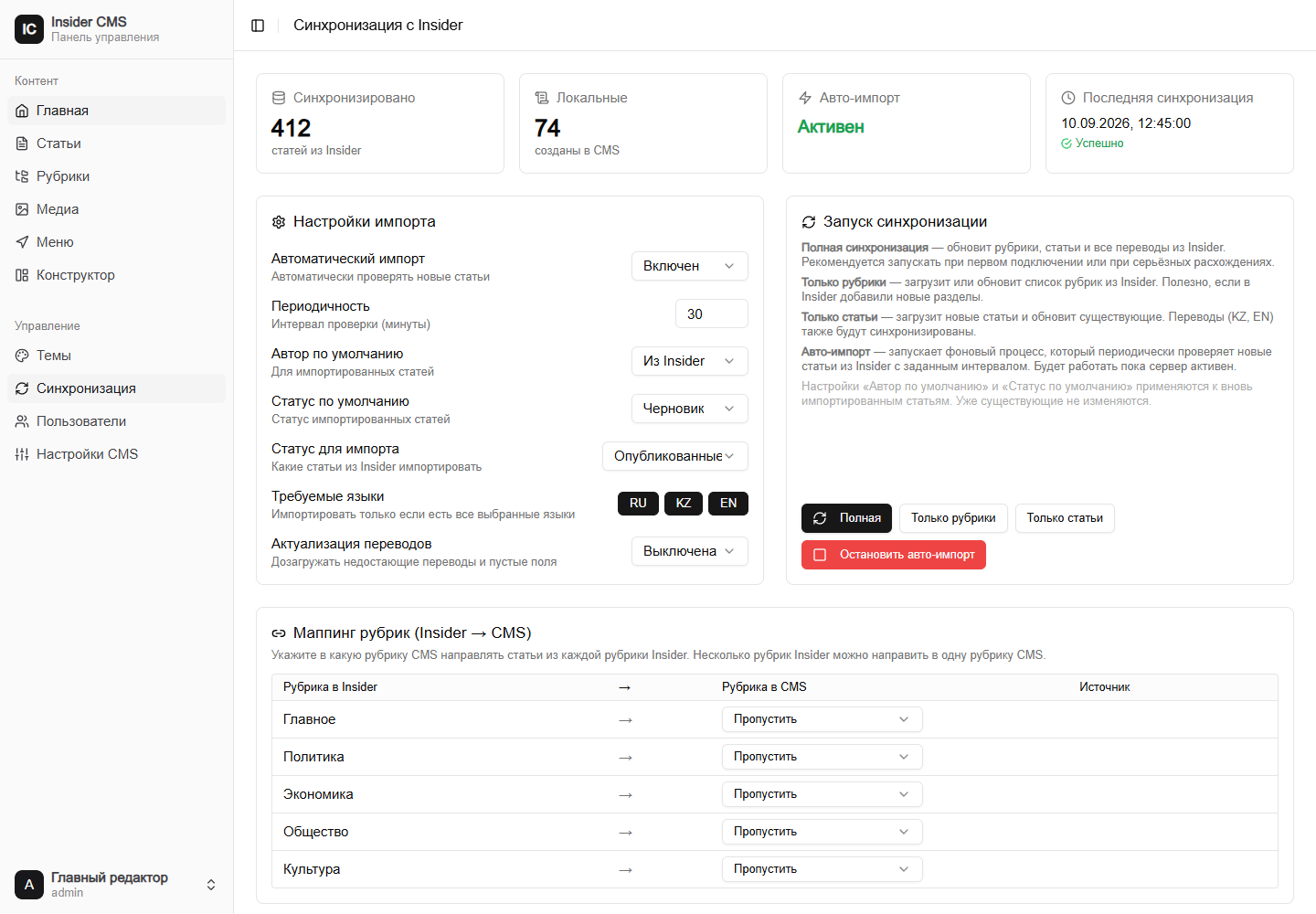
We added full and partial synchronisation, scheduling, category mapping and mandatory-language rules.

03 / Information Architecture

The user journey is built around a meaningful task

Insider API→Express REST API→PostgreSQL + Prisma→Next.js Admin→Editorial Review→Publishing / ISR→Next.js Public

The architecture was verified using the supplied documentation, application structure and genuine product screens.

04 / Core UX

The editor controls the entire publishing workflow, from import to the public page

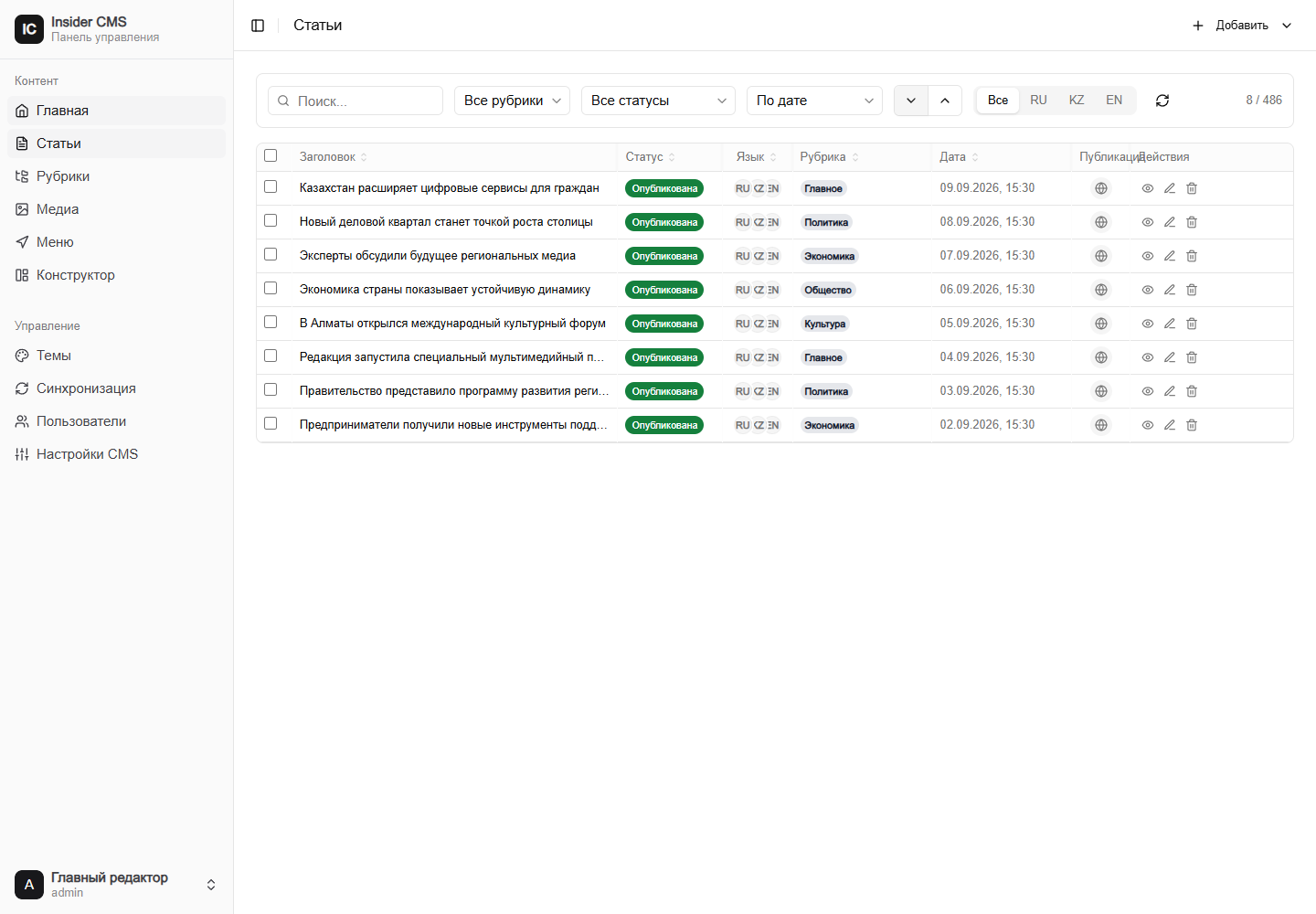
The article list displays statuses, categories, dates and language versions. Synchronization turns technical rules into understandable settings, and the visual builder lets editors assemble home, category and article pages without developer assistance. After publication, the backend invalidates only related cache entries, updating the site without a full rebuild.

Editorial List — Insider CMS
Editorial ListSearch, statuses, languages, sections and bulk actions
Synchronization with Insider — Insider CMS
Synchronization with InsiderSchedule, section mapping and import result monitoring
05 / Content Model

The content model supports the full editorial lifecycle, not merely text storage

Article

Content

Status, date, author, type, section, media and metrics

ArticleTranslation

Language Version

RU/KZ/EN, custom slug, SEO and publication time

PageLayout

Page Mockup

Sections, columns, blocks, order, draft and version

MediaFile

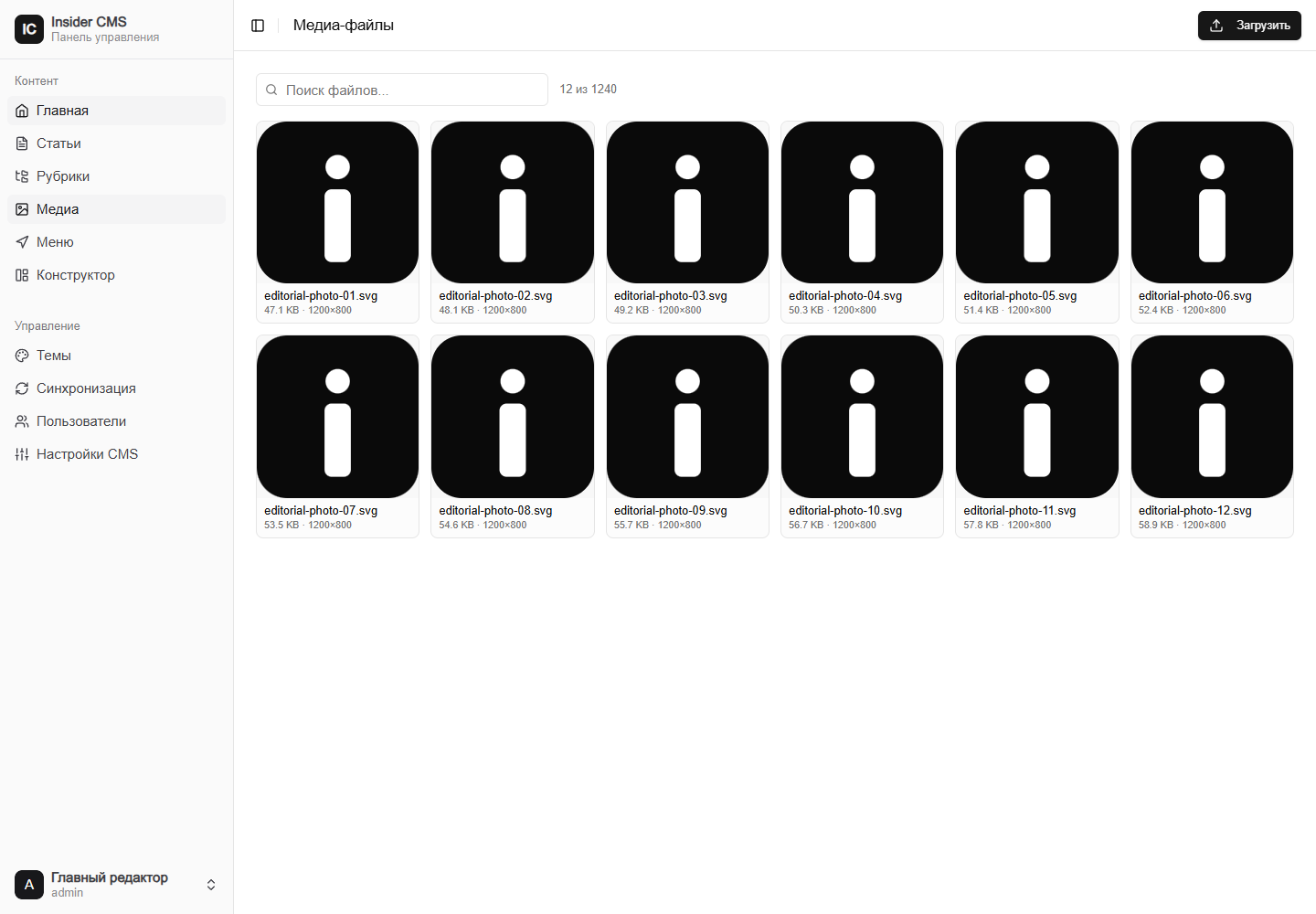
Media Library

MIME, dimensions, file size, alt, caption and Cloudinary URL

SyncLog

Integration Log

Source, result, errors and synchronization time

User / Session / Audit

Access Control

Roles, revocable sessions and change history

06 / Technology Stack

Three applications separate editorial workflows from public content delivery

Express.js 4 + Node.js 22REST API, auth, content, media, sync, layouts and public endpoints
PostgreSQL 16 + Prisma 515 Core Models and 6 Migration Directories
Next.js 14 + React 18Admin panel, Tiptap, dnd-kit, TanStack Query and Recharts
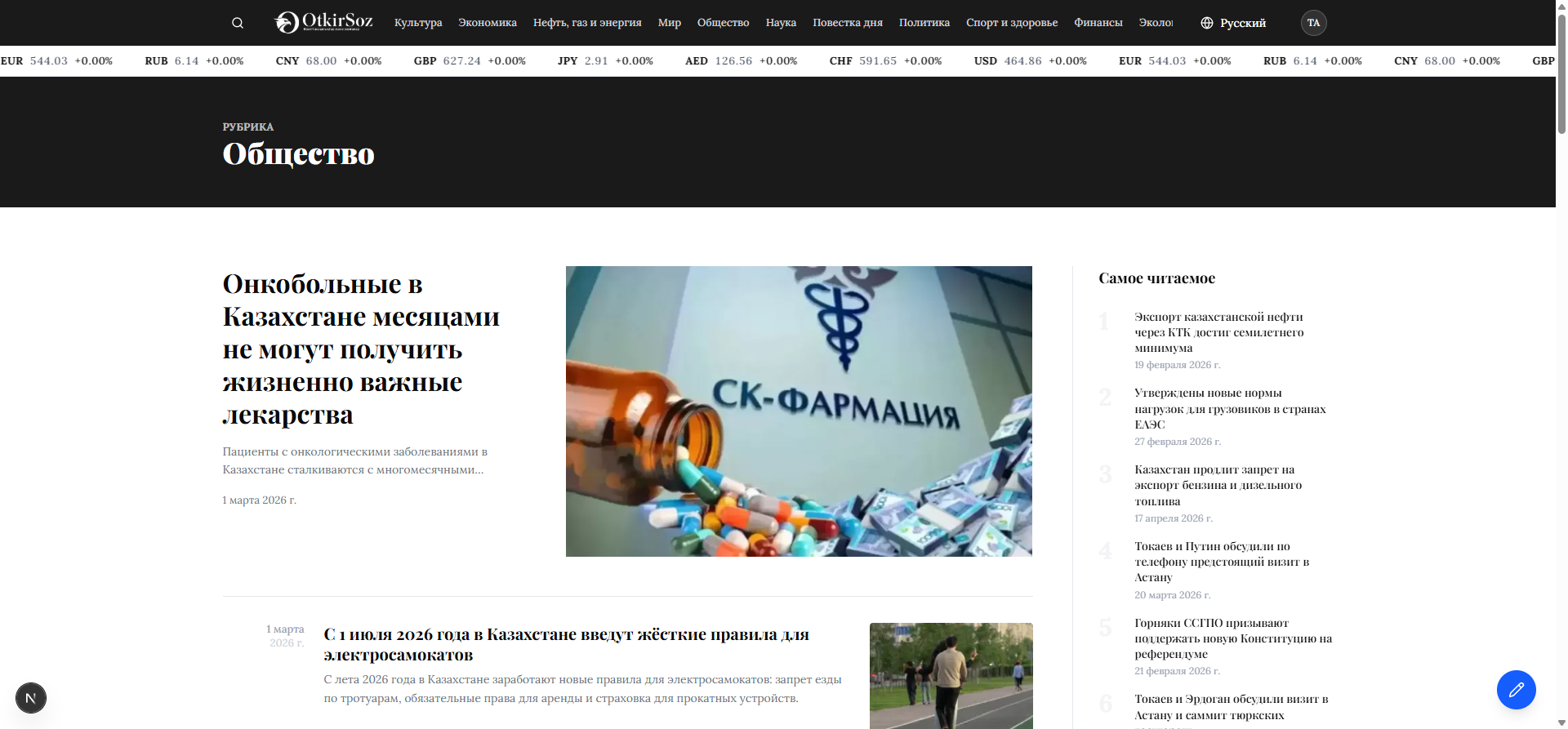
Next.js 16 + React 19Public website with SSR, ISR and tag-based revalidation
Cloudinary + MulterMedia upload, storage and reuse
Docker + health-checkMulti-stage build, startup migrations and /health endpoint
07 / Interactive Flows

The interface helps users complete tasks without unnecessary navigation

Rich-text editor

Tiptap for text, media and structured content

Drag & drop

dnd-kit for sections, columns and 20 block types

Scheduled publish

Scheduled publishing and separate translation statuses

Audience loop

Views, bookmarks, comments and reactions are synced back to the CMS

08 / SEO and Delivery

Search infrastructure integrated into the editorial workflow

The public frontend generates dynamic metadata, canonical URLs, language alternate links, Article and Breadcrumb JSON-LD, a standard sitemap, a Google News sitemap and robots.txt. SSR/ISR provide ready-to-read HTML for search engines, while targeted revalidation updates only changed content. SEO becomes part of the publishing pipeline rather than a manual editorial task.

3languages
2sitemap types
SSR + ISRrendering
JSON-LDArticle + Breadcrumb

The administration panel screenshots use demonstration data but were captured from the working interface. Scale is stated based on the current repository and is not substituted with traffic metrics.

09 / Control Framework

Mobile readers receive the complete publication, not a stripped-down copy

At a width of 375 px, the public website preserves its sections, readable typography, illustrations and links between articles. Content remains server-rendered, and next-intl maintains the structure when switching between RU/KZ/EN.

  • 375 × 812 viewport without horizontal scrolling
  • Standalone URLs for Each Language Version
  • SSR/ISR for Fast Initial Rendering
  • Metadata and structured data generated from the CMS
Mobile Publishing — Insider CMS
Mobile PublishingLive public website interface, 375 × 812
10 / Technical Review

The codebase structure demonstrates the product’s scale

01

76 REST handlers

The API covers authentication, content, media, synchronisation, layout and public data.

02

262 files

Three TypeScript applications separated by responsibility.

03

Security baseline

JWT, bcrypt, Zod, Helmet, CORS allowlist and separate rate limits.

04

Publishing pipeline

Drafting, preview, scheduling, publishing and targeted cache invalidation.

05

Operations

Docker, Prisma migrations, health-check, Winston and error handling.

06

Scalability

The REST API is ready for a mobile application, bot or additional storefront.

11 / Real Interfaces

Key journeys demonstrated through working product screens

12 / Result

The editorial team gains its own digital platform: content stays synchronized, translations are managed independently, pages are assembled visually, and the public portal updates quickly and predictably.

The business value lies in fewer manual transfers, less dependence on developers and unified control over publishing in three languages.

Next.js 14 / 16React 18 / 19Express.js 4PostgreSQL 16Prisma 5
Next Project

Need a custom CMS that shortens the journey from newsroom to reader?

We will analyse the audiences, content, integrations and search demand, then design the structure and technical architecture before visual design begins.

Discuss the Project ↗Back to Case Studies